A standard panel is a starting point, not the finish line. We look past the summary number at what is actually driving your heart risk, then build a prevention-first plan around it.
If these questions sound like yours, a deeper cardiovascular workup can give you answers that a summary number cannot.
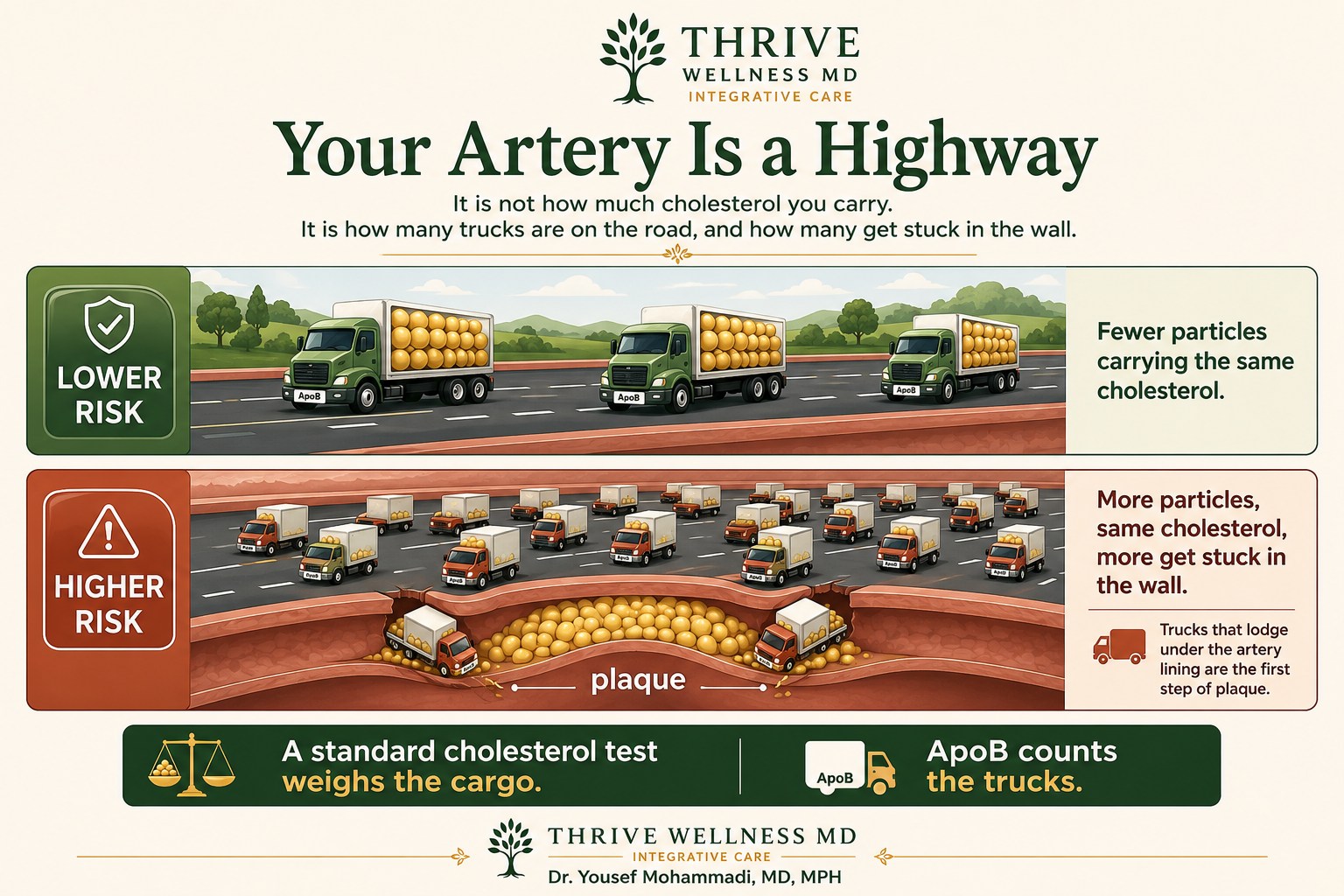
A routine panel reports total cholesterol, low-density lipoprotein (LDL), high-density lipoprotein (HDL), and triglycerides, all concentration measurements. What they do not show is how that cholesterol is carried through your blood, and cholesterol does not travel loose. It rides inside particles.
Two people can have the exact same LDL while one carries it in a few large particles and the other in a large number of small, dense ones, and the second person carries more risk with an identical number on paper. This mismatch shows up most in people with prediabetes or insulin resistance, exactly the group most likely to be told their cholesterol is fine.
High blood pressure and an unfavorable cholesterol pattern are better understood as signals of a few upstream problems, not the whole problem themselves.
The number of cholesterol-carrying particles in your blood tracks risk more closely than the cholesterol amount alone. It can be high even when a standard panel looks reassuring.
Chronic low-grade inflammation and oxidative stress damage the inner lining of your blood vessels. That damaged lining, not cholesterol by itself, is where plaque actually starts to build.
Heart disease and blood sugar problems share the same roots: inflammation, insulin resistance, and chronic stress. That is why we treat them together instead of in separate silos.
An elevated reading is a signal about what is happening in your vessels. We measure it carefully, then look at what is driving it, rather than only pushing the number down.
A useful way to picture it: family history loads the gun, diet and stress and smoking pull the trigger, and excess weight and a poor-quality diet keep it going. Good care works at all three levels.
We build on standard cardiology and primary care, then add the depth that matters most when a basic panel looks fine but your risk may not be.
Family history of early heart disease, waist measurement, blood sugar, autoimmune history, and even chronic gum or dental infection all shape cardiovascular risk. We take the time to map them, because risk is a whole-person picture, not one blood draw.
We start with the standard panel, then add resolution when warranted: LDL particle number for a direct count of the particles that matter, particle size for context, apolipoprotein B (ApoB) as a widely used marker of particle burden, and oxidized LDL as a marker of oxidative damage. We also check lipoprotein(a), or Lp(a), an inherited particle that can raise risk on its own and that a standard panel does not measure. This matters most for patients whose standard panel looks reassuring but whose real risk may not be.
Most people have never had their blood pressure measured in a way that reflects their true numbers. Because your care is virtual, we coach you to measure it correctly at home, with the right cuff, arm position, and rest beforehand. We then work from the average of many home readings rather than a single office snapshot, which also rules out a white-coat effect, and we have you compare both arms, since a real difference can be an early clue.
If you already take heart or blood pressure medication, we check what it may be quietly depleting and help correct it, in coordination with your prescribing physician, a well-documented example being statins and coenzyme Q10 (CoQ10). Any change to the medication itself stays with the physician who prescribes it.
Nutrition and lifestyle are the foundation and the first lever whenever it is safe to lead with them. Medication stays part of the toolkit when it is needed, always in partnership with the physician who prescribes it.
Even a modest amount of weight loss can measurably lower both blood pressure and inflammatory markers, which is why we track those markers, not the scale alone.
Start with a free Meet & GreetRoot-cause cardiovascular care is for prevention, not emergencies. Chest pain, pressure, or tightness, pain spreading to the arm, jaw, neck, or back, sudden shortness of breath, fainting or a sudden irregular or racing heartbeat, sudden weakness, facial droop, or trouble speaking, or a cold sweat with nausea all mean call 911 or go to the nearest emergency room now.
Standard panels measure how much cholesterol is present, not how many particles are carrying it. Particle number can be elevated even when your LDL looks normal, especially with prediabetes, insulin resistance, or a strong family history. That is exactly the gap advanced testing fills.
LDL cholesterol measures how much cholesterol is present. Particle number counts the actual carrier particles. The two do not always move together, and particle number tends to track risk more closely.
Nutrition, movement, sleep, and stress management come first whenever it is safe to lead with them. Medication is added only when it is needed. Any change to an existing prescription is made together with your prescribing physician, never as a do-it-yourself change from a webpage.
Family history raises the value of earlier, more detailed testing. It is an input that changes the workup, not a verdict on your outcome.
We review existing prescriptions for nutrient depletion, such as statins and CoQ10, and build the food and lifestyle plan around what you already take, in coordination with your prescribing physician. When it fits your picture, we also consider personalized cardiovascular supporting supplements to optimize your risk factors. Any change to the medication itself stays with the physician who prescribes it.
Ongoing low-grade inflammation and oxidative stress damage the vessel lining, and that is where plaque starts to build. Calming that process is a central goal of this approach, not an afterthought.
No. Thrive is a cash-pay practice, and any labs are billed separately by the lab. Care is fully virtual by secure video for patients located anywhere in Arizona or Indiana. To begin, book a free 15-minute Meet and Greet.
Start with a free 15-minute Meet and Greet. Tell us what you are dealing with, and we will show you what a deeper cardiovascular workup could look like.
Book your free Meet & Greet