When weight is stuck and energy crashes every afternoon, the problem is usually not willpower. It is often insulin resistance. We look past the scale to find what is actually holding your metabolism back.
If this is your week, there is a reason the usual advice has not worked. It has been treating the scale instead of the cause.
That advice leaves out the levers that actually decide whether it works: hormone signaling, food quality, muscle mass, sleep, stress, and your micronutrient status. That is why the same plan works for one person and fails another.
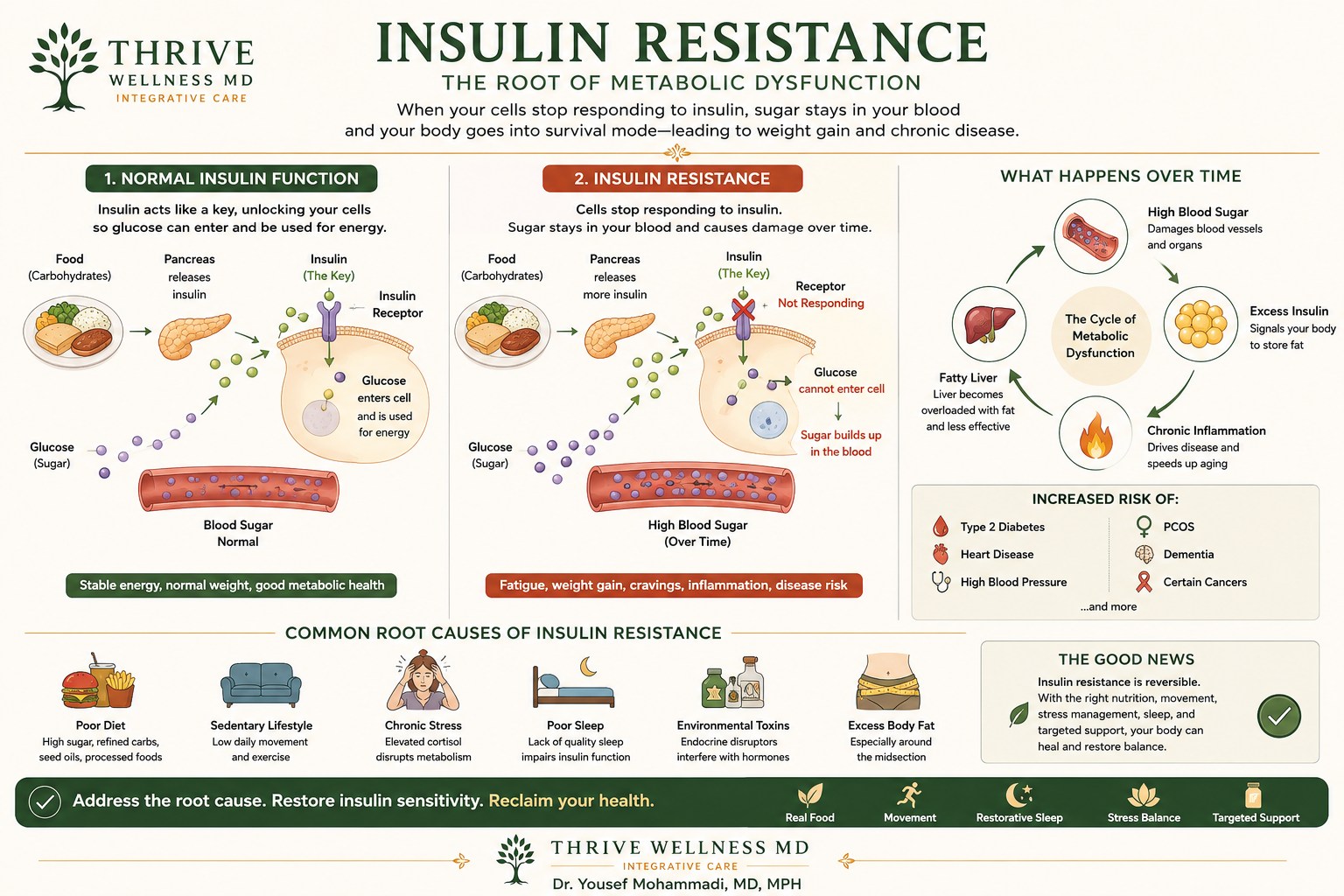
The central mechanism is usually insulin resistance. Insulin moves blood sugar into your cells, and when your cells stop responding well, your body makes more and more of it to keep up. Over time that path runs from insulin resistance to prediabetes to type 2 diabetes, and that progression, not the number on the scale, is the real target.
When cells stop responding to insulin, blood sugar and energy get harder to manage and fat storage gets easier. Calming insulin resistance is the foundation of a real metabolic plan.
Muscle is one of the main places your body puts blood sugar. A body with more, well-fed muscle handles blood sugar better, which is why protein and resistance training are treated as medicine here.
The same calorie behaves differently depending on whether it comes from refined sugar or from fiber, protein, and healthy fat. Refined carbs spike blood sugar and inflammation even when they fit the calorie budget.
Specific nutrients tied to insulin sensitivity, along with poor sleep and chronic stress, all shape how your body handles blood sugar. We check the pieces that generic plans skip.
A real metabolic evaluation looks for why the system is stuck, then builds a plan you can actually keep.
We map your history with diets, your energy pattern through the day, sleep, stress, movement, and what has and has not worked. Repeating the same 20 pounds five times is a pattern, and patterns have causes.
We evaluate blood sugar and insulin, your longer-term average blood sugar, a lipid panel, targeted micronutrients tied to insulin sensitivity, and body composition, so we see muscle and fat, not one number on the scale. Checking blood levels first means support is matched to your gaps, not a generic stack. Wearables you may already own, like an Oura Ring, Whoop, or Apple Watch, add another layer between visits. The sleep, activity, resting heart rate, and recovery they track all shape your metabolism, and we can use those patterns to fine-tune your plan with meaningful day-to-day data.
Your food plan is tailored to your metabolic picture, often a higher-protein, lower-carbohydrate pattern when it fits, with protein anchoring every meal to steady blood sugar and protect muscle. Exercise is prescribed too: a real plan with frequency, intensity, time, and type across both cardio and strength, reassessed over time, not a blanket instruction to move more.
When it is clinically appropriate for you, medication can be part of the plan. It works best as an accelerant inside the full program, so the gains are more likely to hold, not as the entire plan by itself.
Some patients ask specifically about GLP-1 medications like semaglutide or tirzepatide. When appropriate, these can be one tool inside a personalized program alongside nutrition, exercise, micronutrient correction, and behavior change, never a standalone fix and not right for everyone. Whether they fit is a medical decision we make together.
Weight that will not move often comes down to insulin resistance, food quality and timing, muscle mass, sleep, and stress. Calorie count alone misses the levers that actually decide the result. We look for which of those is stuck for you.
Insulin resistance means your cells stop responding well to insulin, so your body makes more of it to keep blood sugar in range. It often shows up as afternoon crashes, sugar cravings, and stubborn belly fat. Testing blood sugar and insulin markers helps confirm it rather than guessing from symptoms alone.
We test. Evaluation looks at blood sugar and insulin, longer-term average blood sugar, a lipid panel, targeted micronutrients, and body composition, so the plan is built on real data about your metabolism. When it helps, a continuous glucose monitor (CGM) shows how your blood sugar responds to meals, sleep, and stress in real time, so we can personalize your plan around your actual patterns.
When it is clinically appropriate, a GLP-1 medication can be one tool inside your program. Whether it fits you is a medical decision we make together after a full evaluation. It is used alongside nutrition, exercise, and the rest of the plan, so the results are more likely to last, not as a shortcut on its own.
Yes. Medication works best as part of a full plan. Nutrition, protein, resistance training, sleep, and stress work are what protect your muscle and help the improvements hold over time. That is the whole point of building the program around you. Every medication has side effects, so our goal is to get you the most benefit with the fewest. If you are on a GLP-1, the right dose and the right supporting steps make a real difference in how well it works and how you feel. The source and quality of the medication matter just as much, so we are careful about where it comes from.
We look for why your metabolism is stuck, personalize the food plan and macronutrient ratio, prescribe exercise with real structure, correct lab-identified micronutrient gaps, and use trackable goals. The generic advice is not wrong. It is incomplete.
No. Thrive is a cash-pay practice, and any labs are billed separately by the lab. Visits are by secure video from anywhere in Arizona or Indiana, and in-person visits are available by appointment. To begin, book a free 15-minute Meet and Greet.
Start with a free 15-minute Meet and Greet. Tell us what you are dealing with, and we will show you what a root-cause metabolic plan could look like.
Book your free Meet & Greet