Hormone optimization · women & men

Told your hormones are normal, but you know something is off?

Fatigue, low libido, mood swings, poor sleep, and stubborn weight are real signals. We look at how your hormones are made, carried, and cleared, not one number on a page.

Does this sound like you?

The symptoms are different for women and men. The pattern is the same.

For women

Perimenopause, menopause, and premenstrual syndrome (PMS)
  • Hot flashes or night sweats that break your sleep.
  • Mood swings, new anxiety, or a low mood that feels unfamiliar.
  • Brain fog, losing words, walking into a room and forgetting why.
  • Low sex drive, vaginal dryness, or discomfort.
  • Weight gain around the middle with no change in habits.
  • Periods that are heavier, irregular, or come with worse PMS.
  • Fatigue that a full night of sleep does not fix.

For men

Low testosterone and andropause
  • Low energy no matter how much you sleep.
  • Low sex drive or new difficulty with erections.
  • Losing muscle, or unable to build it despite training.
  • More belly fat that will not shift.
  • Flatness, irritability, or low motivation.
  • Brain fog and trouble focusing.
  • Disrupted sleep and thinning hair.

If several of these are true for you, your hormones are worth a closer, more complete look than a single blood draw usually gives.

More than reproduction

Your hormones touch nearly every system

Sex hormones do far more than drive reproduction. They shape your brain and mood, muscles, heart, metabolism, sleep, and bones, which is why the symptoms of imbalance show up all over the body, not just in one place.
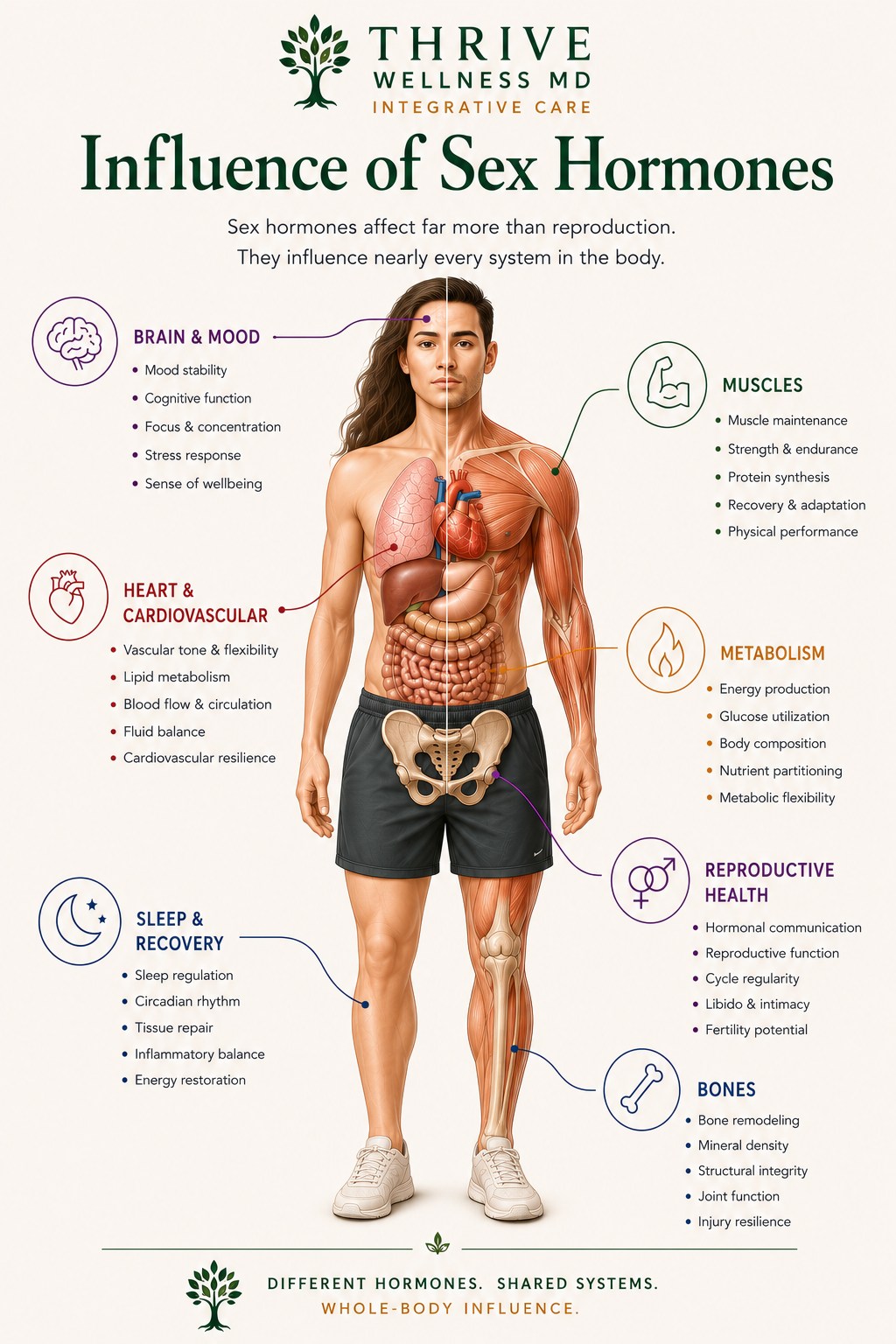
The whole-body influence of sex hormones. Estrogen, progesterone, and testosterone affect the brain and mood, including mood stability, cognitive function, focus, stress response, and wellbeing; the muscles, including maintenance, strength, protein synthesis, and recovery; the heart and cardiovascular system, including vascular tone, lipid metabolism, blood flow, and fluid balance; metabolism, including energy production, glucose utilization, body composition, and metabolic flexibility; sleep and recovery, including sleep regulation, circadian rhythm, tissue repair, and inflammatory balance; reproductive health, including libido, cycle regularity, and fertility; and the bones, including remodeling, mineral density, structural integrity, and joint function.
The whole-body influence of sex hormones, from brain and mood to bones.
You are not imagining it

A normal total number can still leave you symptomatic

Here is what a standard panel often misses. Most of your testosterone and estrogen travels attached to a carrier protein, sex hormone binding globulin (SHBG), and hormone bound to SHBG is parked and unavailable. So a man can have a total testosterone that reads normal and still feel low, because too much of it is bound up and not free to work.

A hormone is never simply high or low in a vacuum. It moves through a chain: produced, converted into other forms, carried through the blood, then cleared. A problem at any link causes the same symptoms as a problem with the hormone itself, which is why we look at the whole chain, not one snapshot.

Why the numbers can look fine

The five places hormone balance actually breaks

Two people can share the same lab value and feel completely different, because what matters is how the whole system is working underneath it.

Production

Estrogen, progesterone, and testosterone are made in the ovaries, testes, and adrenal glands, and in midlife a meaningful share also comes from other tissue via a precursor hormone. Output shifts, so hormone status does not track age in a straight line.

Conversion

Hormones convert into other hormones. In some men more testosterone is turned into estrogen than is helpful, often driven by excess body fat or inflammation, which worsens low-testosterone symptoms and changes the plan.

Binding (SHBG)

When SHBG runs high, more hormone is parked and unavailable, so you feel low even when the total looks normal; when it runs low, more is active and can look like symptoms of excess. We read it alongside the total.

Clearance

Once estrogen has done its job, the body breaks it down and clears it in stages, and some routes are considered safer than others. Genetics, gut health, nutrition, and everyday chemical exposure all shape how efficiently you clear it.

Stress and cortisol

Cortisol follows a daily rhythm, and ongoing stress keeps that system switched on longer than it is built for, which can suppress your sex hormones and worsen nearly every symptom above. We evaluate it in the same visit, not as a separate problem.

How Dr. Mohammadi investigates

Testing that shows the pattern, beyond the level

Root-cause hormone care starts with a full history, then chooses testing that fits your picture, so the plan is built on how your body actually works.

Your full story and goals

We start with your symptoms, cycle or andropause history, sleep, stress load, mood, libido, and what you want to get back. Bone density loss has no symptoms until a fracture, which is one reason we take midlife hormone health seriously before things get severe.

Serum (blood) testing for a precise baseline

Blood gives a clear, single-moment reading of hormone levels and SHBG, and serum confirmation is required before starting or adjusting testosterone or dehydroepiandrosterone (DHEA) therapy. A borderline result is always confirmed in blood before any treatment begins, which is a safety step.

DUTCH testing when the standard panel looks fine but you do not feel fine

The DUTCH test, short for Dried Urine Test for Comprehensive Hormones, is a panel collected across a day, sometimes paired with saliva for the morning cortisol pattern, and it shows how your body produces, converts, and clears each hormone, not just a level. It adds your estrogen clearance route, your testosterone pathway, a full daily cortisol curve, and a clearer read on perimenopausal versus postmenopausal patterns, so serum and DUTCH work together.

A plan built around your biology

Your plan starts with the foundations that help every hormone pattern: nutrition, movement with resistance training, blood sugar balance, sleep, and active stress work. From there we add targeted, physician-guided support and, when it is appropriate for you, prescription hormone therapy with the monitoring it requires.

Treatment, matched to you

From foundations to prescription therapy, in that order

Many patients feel meaningfully better from the foundational and targeted support before any prescription. When hormone therapy is the right tool, it is dosed to you and monitored on a real schedule, never handed out as a one-time script.

Foundations firstNutrition, resistance training, blood sugar, sleep, and stress work for everyone.
Targeted supportPhysician-guided nutrient and lifestyle support matched to your test pattern.
Hormone therapy when rightBioidentical therapy for women, testosterone or DHEA for confirmed low levels, with monitoring.
Start with a free Meet & Greet
Hormone therapy is not risk-free and it is not for everyone, and that honest conversation is part of the care. At Thrive it is prescribed only after a full evaluation and blood confirmation, with monitoring appropriate to what is prescribed. Testosterone and DHEA are not used in pregnancy or breastfeeding, or with current or high-risk breast cancer, and we review your personal risks with you before anything begins.
Common questions

Hormone questions patients ask

My bloodwork came back normal, so why do I still feel awful?

A standard panel usually checks a couple of numbers at a single moment. It does not show how your body is producing, converting, or clearing those hormones over time, or how much is actually free to work rather than bound to SHBG. That is often where the real answer is hiding.

What is the difference between the blood test and the urine test you use?

Blood gives a precise, single-moment snapshot of hormone levels, and it is required before starting or adjusting testosterone or DHEA therapy. The dried-urine DUTCH test adds a full day-long cortisol pattern and shows how your estrogen and testosterone are being metabolized, beyond their starting levels. We use them together.

Can a man's low-testosterone symptoms actually be an estrogen problem?

Sometimes. Some men with classic low-testosterone symptoms are converting more of their testosterone into estrogen than is helpful. That is why evaluation looks at that conversion step specifically, and reads more than the total testosterone number. It can change the treatment plan.

Is bioidentical hormone therapy safe?

It can be a well-studied, appropriate option for many patients when it is dosed to the individual and monitored on a regular schedule. It also carries real risks that deserve an honest discussion, which is why we confirm labs before starting and recheck at set intervals rather than treating it as a one-time prescription.

Do I need hormone therapy, or can this be handled without medication first?

Many patients see real improvement from the foundational nutrition, sleep, stress, and targeted support before or alongside any prescription. Medication is one tool in the plan, not automatically the first one. What is right for you comes out of your history and your labs.

How often will I be retested once I start treatment?

Ongoing hormone therapy comes with a monitoring schedule so dosing stays both effective and safe. For testosterone or DHEA specifically, that includes additional checks such as prostate-related monitoring in men, blood count, and liver labs. We set the exact schedule with you.

Do you take insurance?

No. Thrive is a cash-pay practice, which lets Dr. Mohammadi spend real time getting to the root of how you feel. You always know the cost before you book, and any labs are billed separately by the lab.

Where do you see patients, and how do I start?

Care is fully virtual by secure video for patients located anywhere in Arizona or Indiana. To begin, book a free 15-minute Meet and Greet, a relaxed conversation to see if we are the right fit.

Ready to understand your hormones?

Start with a free 15-minute Meet and Greet. Tell us what you are dealing with, and we will show you what a complete hormone evaluation could look like.

Book your free Meet & Greet