Thyroid health

Exhausted, gaining weight, and told your thyroid is normal?

A single lab in the normal range does not always tell the whole story. We run a complete thyroid panel and look for the real reason you do not feel like yourself.

Does this sound like you?

When your body slows down and no one can tell you why

You are gaining weight, or cannot lose it, even with diet and exercise.
You are tired or exhausted more than you should be.
Your hands and feet are cold, and you feel cold when others are comfortable.
Your hair is dry, brittle, thinning, or falling out, and your skin is dry.
The outer edge of your eyebrows is thinning.
Brain fog makes it hard to concentrate or remember things.
Your mood is low, and your sex drive has dropped.
You are constipated, puffy, or your cycles have changed.
There is thyroid or autoimmune disease in your family.
You were told your thyroid is fine, but you know something is off.

Any one of these is easy to brush aside. Several together are worth a closer look at your thyroid and what may be driving it.

You are not imagining it

One normal number is not a full thyroid evaluation

Most people are told their thyroid is fine after a single test, usually TSH. But TSH mostly reflects the signal your brain sends to the thyroid. It does not show how much active hormone is actually circulating, or how well your cells use it, and that is often where the answer lives.

There is also a difference between technically normal and right for you. A number can sit inside the lab range while you still feel flat, foggy, and cold, and when your symptoms and history point at the thyroid, that is worth taking seriously.

Why normal labs can miss it

Your thyroid is a production-and-delivery chain

The thyroid is not a single on-off switch. Hormone has to be made, converted to its active form, kept free of the brake, and then heard by your cells, and things can go wrong at any point even when the headline number looks fine.
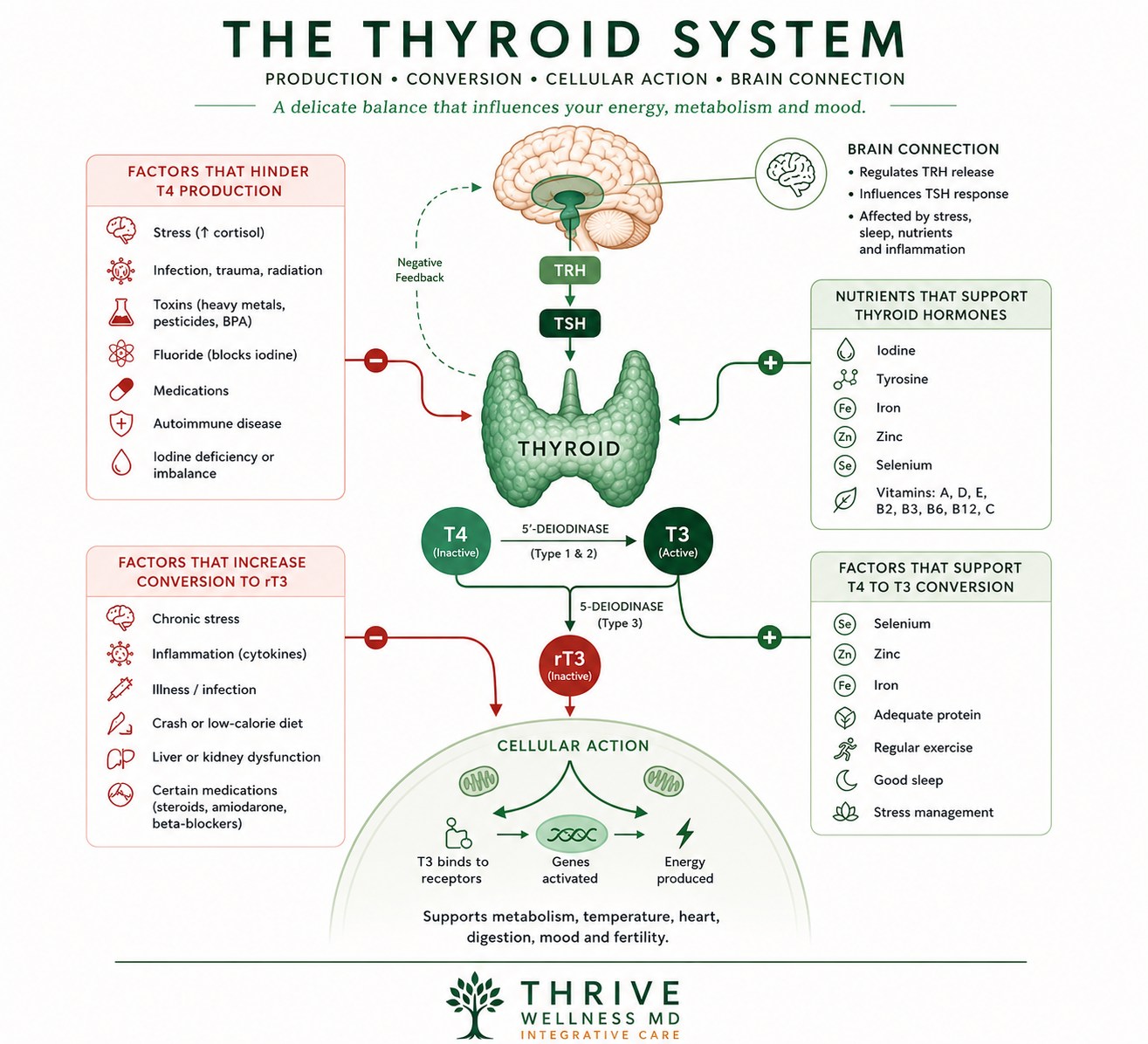
The thyroid system explained: the brain releases TRH and then TSH to signal the thyroid gland, which uses iodine, tyrosine, iron, zinc, selenium and vitamins to make the storage hormone T4. The enzyme 5-prime deiodinase, types 1 and 2, converts T4 into active T3, while type 3 deiodinase produces inactive reverse T3. Active T3 binds to cell receptors, activates genes, and produces energy that supports metabolism, temperature, heart, digestion, mood and fertility. The diagram also lists factors that hinder T4 production, factors that increase reverse T3, and the nutrients and habits that support healthy thyroid production and T4 to T3 conversion.
The Thyroid System: production, conversion, cellular action, and the brain connection.

Production

Your thyroid needs raw materials to make hormone at all, including iron, iodine, selenium, zinc, and several vitamins. Shortfalls, ongoing stress, and certain toxins can quietly limit output.

Conversion

The thyroid mostly releases a storage form, T4, that your body must convert into the active form, T3. A lot of normal labs, terrible symptoms cases hide right here, at the conversion step.

The brake (reverse T3)

Under stress, illness, crash dieting, or environmental exposures, the body can shunt T4 into an inactive mirror form called reverse T3. It competes with real T3 at the cell, so active hormone can look adequate on paper and still be blunted.

Cellular sensitivity

Even with enough active hormone in the blood, your cells still have to respond to it. Nutrients like vitamin A and zinc, and regular exercise, all support how well your cells hear the thyroid signal.

Two everyday medications are worth knowing about, because many people take them with no idea of the thyroid link. Long-term acid-reflux medication and certain blood pressure medications called beta-blockers can each reduce how well your body converts T4 into active T3.

This is not a reason to change anything on your own. It is a reason to look at the whole chain and coordinate with the physician who prescribes them. The most common cause of an underactive thyroid is Hashimoto's, where the immune system attacks the thyroid, and its well-documented link to gut health is one reason we evaluate the two together.

How Dr. Mohammadi investigates

We look at the whole thyroid picture

A real thyroid evaluation is more than one lab. It is your story, a complete panel, and a search for what is actually driving the problem.

Your full story and risk factors

Beyond your symptoms, we map family history of thyroid or autoimmune disease, any past thyroid problem such as Hashimoto's or a nodule, prior radiation to the head or neck, and a history of infertility or miscarriage. A careful look at your skin, hair, nails, and neck adds real clues.

A complete thyroid panel, well beyond TSH

We measure the full picture, well beyond TSH: free T4 and free T3 for the active hormone actually available to you, reverse T3 to see whether your body is braking, and thyroid antibodies (TPO and thyroglobulin) for the autoimmune cause behind so many thyroid problems. We also check the nutrients your thyroid depends on, such as iron, vitamin D, selenium, zinc, and B12.

The root causes we look for

A struggling thyroid usually has a reason underneath, and that is what we treat: autoimmune disease such as Hashimoto's and its strong link to gut health and celiac; missing building blocks like iodine, iron, selenium, zinc, and key vitamins; chronic stress and inflammation that raise reverse T3; and thyroid-disrupting environmental toxins.

A plan built around your biology

Your plan fits what we find: targeted nutrition and nutrients, stress, sleep, and gut support to improve how you make and use thyroid hormone, plus thyroid medication when appropriate. When standard treatment is not enough, we can look at T3 and combination options and address reverse T3, so treatment matches how your body actually responds.

What changes for you

Feeling steady again

Imagine steady energy through the day, a clearer head, your weight responding again, warmer hands, and the sense that your body is finally on your side. That is the goal: a real answer, a plan that fits you, and support while your body finds its rhythm.

Start with a free Meet & Greet

Some thyroid symptoms need prompt attention

Most thyroid concerns are not urgent, but a few should be evaluated soon: a new or growing lump in the neck, trouble swallowing or breathing, a racing or irregular heartbeat, worsening neck fullness or pressure, bulging eyes or vision changes, or sudden, severe, or rapidly worsening symptoms. If any apply, please tell us or see a provider promptly.

Common questions

Thyroid questions patients ask

My thyroid labs were normal. Why do I still feel this way?

A standard screen is often just TSH, which reflects the signal to the thyroid, not how much active hormone your body actually makes or uses. A complete panel plus a look at what may be affecting your thyroid often explains symptoms that one number does not.

What is the difference between TSH, free T4, free T3, and reverse T3?

TSH is the brain's request for more or less hormone. Free T4 is the main storage form. Free T3 is the active form your cells actually use. Reverse T3 is an inactive form that can block T3's effect when it builds up. Seeing all four together tells a much fuller story than TSH alone.

What is Hashimoto's, and do you test for it?

Hashimoto's is an autoimmune condition where the immune system slowly attacks the thyroid. It is the most common cause of an underactive thyroid, and it can be present even when TSH still looks normal. Yes, we check thyroid antibodies to look for it, which a basic screen usually skips.

Do you only prescribe levothyroxine, or other options too?

It depends on you. Many people do well on standard T4 medication like levothyroxine. When that is not enough, or when your body is not converting hormone well, we can consider T3 and combination approaches and address reverse T3. When it is a good fit clinically, or when it is what you are interested in, we also consider more natural hormone replacement options like desiccated thyroid, such as Armour Thyroid or NP Thyroid. Every choice is matched to your labs and how you feel.

Is it safe to just start taking iodine or selenium on my own?

Not without testing first. Both too little and too much iodine can worsen thyroid function, and selenium adds up faster than most people expect. Supplementation should follow your labs, not guesswork, which is exactly why we test before we recommend.

Can diet and lifestyle really affect my thyroid?

Yes. Your thyroid depends on nutrients like iodine, iron, selenium, and zinc, and it is affected by stress, inflammation, gut health, and toxins. Addressing those does not replace medication when you need it, but it often helps your thyroid and your treatment work better.

I already have a doctor or endocrinologist managing my thyroid. Can I still come here?

Yes. Root-cause thyroid evaluation is meant to add depth to the picture, alongside the care you already have. We coordinate rather than compete, and any medication you are prescribed stays with the physician managing it.

Do you take insurance, and where do you see patients?

No. Thrive is a cash-pay practice, and labs are billed separately by the lab. Care is fully virtual by secure video for patients located anywhere in Arizona or Indiana. To begin, book a free 15-minute Meet and Greet.

Ready for a real thyroid answer?

Start with a free 15-minute Meet and Greet. Tell us what you are dealing with, and we will show you what a complete thyroid evaluation could look like.

Book your free Meet & Greet